
The ALARP Principle Explained: Reducing Risk to a Practical, Defensible Level
Every workplace carries some level of risk — operating heavy machinery, handling hazardous chemicals, working at height. Eliminating all of it is rarely possible, especially in high-hazard industries. What organizations can do is reduce risk to a level that is As Low As Reasonably Practicable (ALARP) — a structured, evidence-based approach to making risk decisions that balances safety, practicality, and operational reality.
What Is the ALARP Principle?
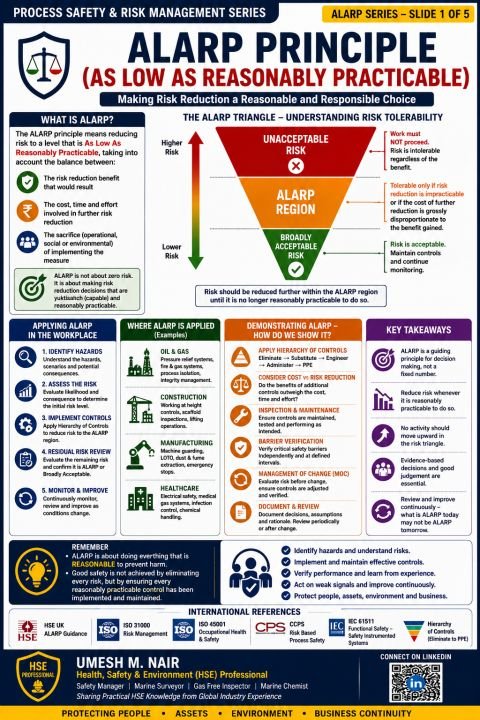
ALARP requires organizations to reduce workplace risk to the lowest level that is reasonably achievable. It doesn’t demand zero risk — it demands that every reasonably practicable control be implemented before any residual risk is accepted.
The rule of thumb: an organization should only stop adding further controls once the additional cost, time, or effort required would be grossly disproportionate to the extra safety benefit gained. If a practical measure can meaningfully improve safety, it should be implemented — not skipped for convenience or production pressure.
Decisions under ALARP should rest on recognized engineering practice, operational experience, and credible risk assessment — not on shortcuts.
Understanding the ALARP Triangle
The principle is best understood through a triangle divided into three risk zones.
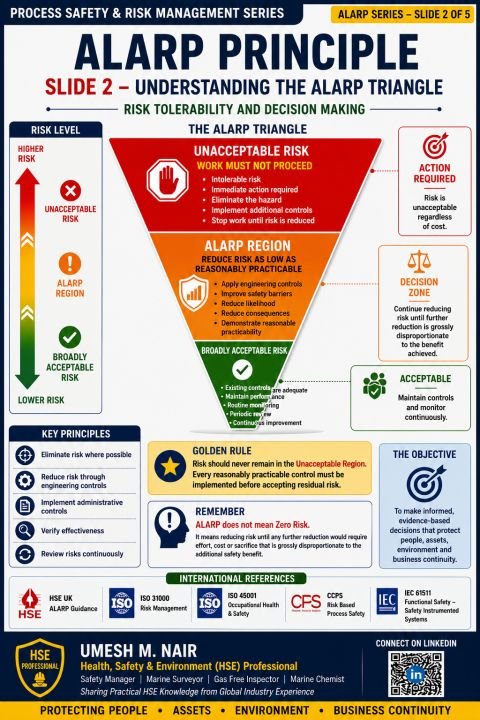
🔴 Unacceptable Risk
The highest zone. Risk here is intolerable regardless of the benefit, and work must not proceed. Examples include working at height without fall protection, operating defective machinery, entering confined spaces without gas testing, or handling hazardous chemicals without proper controls. Immediate action is required — hazards must be eliminated or controls introduced before work continues.
🟠 ALARP Region
The tolerable risk zone. Risk has been reduced to a manageable level, but organizations must keep asking whether further reasonably practicable improvements exist. This is a decision zone: reduction continues only until further sacrifice becomes grossly disproportionate to the benefit achieved. Regular monitoring, inspection, and review are essential here.
🟢 Broadly Acceptable Risk
The lowest zone. Remaining risk is minimal and acceptable under normal operating conditions, maintained through routine supervision, maintenance, and procedural compliance.
Golden Rule: Risk should never remain in the unacceptable region. Every reasonably practicable control must be implemented before residual risk is accepted — and ALARP does not mean zero risk. It means further risk reduction would require effort, cost, or sacrifice grossly disproportionate to the additional safety benefit.
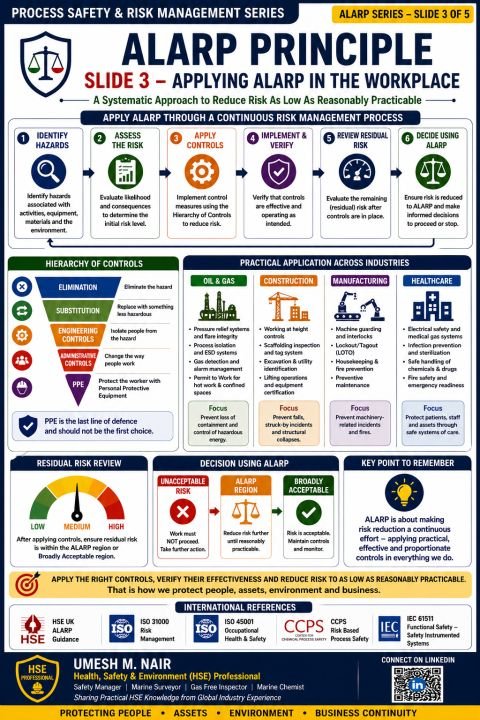
Applying ALARP: A Continuous Risk Management Process
ALARP isn’t a one-time checkbox — it’s a repeating cycle applied through a systematic process:
- Identify Hazards – Recognize anything tied to activities, equipment, materials, or the environment that could cause harm: mechanical equipment, electrical systems, hazardous substances, fire hazards, confined spaces, or work at height.
- Assess the Risk – Evaluate the likelihood of an incident, its potential consequences, and how effective existing controls already are.
- Apply Controls – Implement risk-reduction measures using the Hierarchy of Controls (below), starting with the most effective options.
- Implement & Verify – Confirm that controls are actually in place and operating as intended — not just documented on paper.
- Review Residual Risk – Evaluate the risk that remains after controls are in place and decide whether further action is warranted.
- Decide Using ALARP – Determine whether the residual risk sits in the unacceptable, ALARP, or broadly acceptable zone, and act accordingly.
The Hierarchy of Controls
When implementing risk controls, higher-level measures provide stronger, more reliable protection than relying on the worker alone:
| Level | Control | What It Does |
|---|---|---|
| 1 (Strongest) | Elimination | Removes the hazard entirely |
| 2 | Substitution | Replaces it with something less hazardous |
| 3 | Engineering Controls | Isolates people from the hazard |
| 4 | Administrative Controls | Changes how the work is performed |
| 5 (Last line of defense) | PPE | Protects the worker directly |
PPE is the last line of defense and should never be the first — or only — control considered.
How to Demonstrate ALARP
Reducing risk isn’t enough on its own — organizations also need to be able to prove that risk has genuinely been brought down to ALARP. This is typically demonstrated through six principles:
- Apply the Hierarchy of Controls – Always aim for the highest level of control possible; document the decision and justification for the level chosen.
- Cost vs. Risk Reduction – Compare the sacrifice (time, cost, effort) against the risk-reduction benefit; only skip further reduction if it’s genuinely disproportionate.
- Inspection & Maintenance – Ensure equipment integrity through defined inspection and maintenance plans, with timely corrective actions and proper records.
- Barrier Verification – Identify critical safety barriers, verify their design, installation, and operational effectiveness, and test them functionally.
- Management of Change (MOC) – Evaluate risk before any change — technical, operational, or human — and update procedures and training accordingly.
- Documentation & Review – Record risk assessments, decisions, and controls; review periodically or whenever conditions change. If it isn’t documented, it effectively didn’t happen.
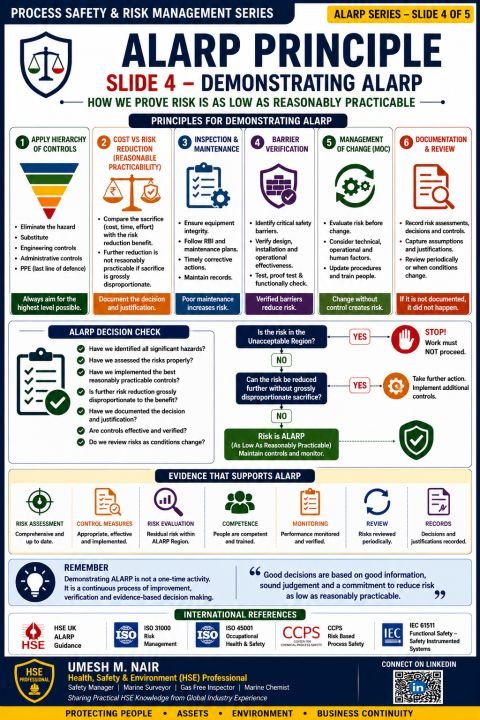
A quick ALARP decision check:
- Have significant hazards been identified?
- Have risks been properly assessed?
- Have the best reasonably practicable controls been implemented?
- Is further risk reduction grossly disproportionate to the benefit?
- Have controls been documented and verified?
- Are risks reviewed as conditions change?
Why the ALARP Principle Matters
- Improves workplace safety by reducing hazards before they turn into incidents, protecting employees, contractors, visitors, and surrounding communities.
- Supports better risk management with a structured framework for evaluating risk and choosing effective controls.
- Enhances regulatory compliance, since many international standards recognize ALARP as best practice — and demonstrating ALARP supports due diligence.
- Optimizes safety investment by prioritizing measures that deliver the greatest real reduction in risk, rather than spending on controls with minimal added benefit.
- Strengthens safety culture, since employees engage more when they understand safety decisions are grounded in practical, evidence-based reasoning rather than arbitrary rules.
- Protects business continuity by avoiding unplanned downtime, legal penalties, and reputational damage tied to preventable incidents.
Where ALARP Is Applied Across Industries
ALARP is used across virtually every high-hazard sector, with the specific controls looking different depending on the operation:
| Industry | Typical Focus |
|---|---|
| Oil & Gas | Pressure relief systems, flare integrity, process isolation, ESD systems |
| Construction | Working at height controls, scaffolding inspection, gas system checks, excavation/utility identification, lifting operations and equipment certification |
| Manufacturing | Machine guarding, interlocks, lockout/tagout (LOTO), housekeeping, fire prevention |
| Healthcare | Electrical and medical gas systems, infection prevention, safe handling of chemicals/drugs, fire and emergency readiness |
Other sectors relying heavily on ALARP include chemical processing, power generation, mining, aviation, maritime, and logistics/warehousing.
Common Misconceptions About ALARP
“ALARP means accepting risk without action.” Not true — ALARP requires organizations to demonstrate that every reasonably practicable measure has been considered and implemented where appropriate.
“ALARP is only about cost.” Cost is one factor, but organizations must also weigh the severity of potential harm, legal obligations, available technology, industry best practice, and the overall safety benefit of additional controls.
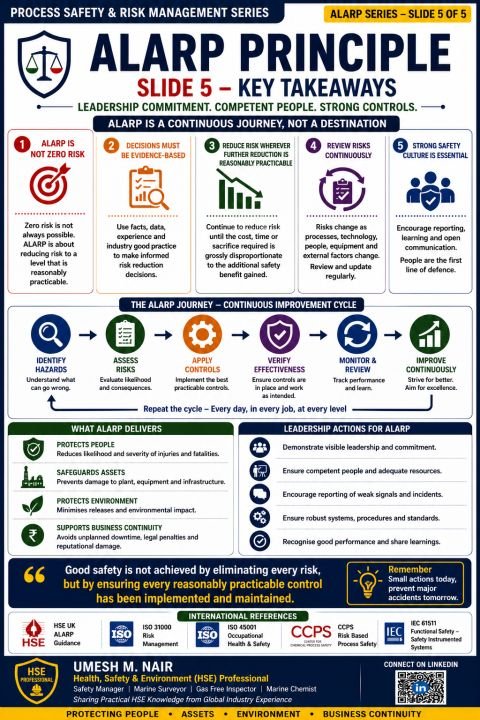
Key Takeaways
- ALARP is a journey, not a destination — risk changes as processes, technology, people, equipment, and external factors change, so the cycle repeats at every level, every day.
- Decisions must be evidence-based — grounded in facts, data, experience, and industry good practice.
- Reduce risk wherever further reduction is reasonably practicable — continue until the cost, time, or sacrifice required becomes grossly disproportionate to the additional safety benefit.
- Review risks continuously — as processes, technology, people, equipment, and external factors change.
- Strong safety culture is essential — people are the first line of defense, and open reporting and communication keep the whole system working.
International Standards That Reflect ALARP
The ALARP principle is embedded in several internationally recognized frameworks, including the UK HSE’s ALARP guidance, ISO 31000 (Risk Management), ISO 45001 (Occupational Health & Safety), CCPS Risk-Based Process Safety, and IEC 61511 (Functional Safety – Safety Instrumented Systems). While specific regulatory requirements vary by industry and country, the underlying objective is consistent: reduce risk through practical, proportionate, and defensible decision-making.
Frequently Asked Questions
Q: Does ALARP mean zero risk? A: No. ALARP means reducing risk to a level where further reduction would require effort, time, or cost grossly disproportionate to the additional safety benefit gained — not eliminating risk entirely.
Q: What are the three zones of the ALARP triangle? A: Unacceptable Risk (work must not proceed), the ALARP Region (tolerable risk requiring ongoing improvement), and Broadly Acceptable Risk (minimal risk maintained through routine controls).
Q: How is ALARP demonstrated in practice? A: Through applying the Hierarchy of Controls, weighing cost against risk reduction, maintaining inspection and maintenance programs, verifying safety barriers, managing change properly, and documenting every decision and review.
Q: Which industries commonly apply the ALARP principle? A: Oil and gas, construction, manufacturing, healthcare, chemical processing, power generation, mining, aviation, maritime, and logistics/warehousing all rely on ALARP for structured risk management.
Good safety isn’t achieved by eliminating every risk, but by ensuring every reasonably practicable control has been implemented and maintained. Reducing risk is not a one-time task — it’s a continuous commitment to building a safer workplace.